cartagen.smooth_catmull_rom#
- smooth_catmull_rom(geometry, subdivisions=10, alpha=0.5)#
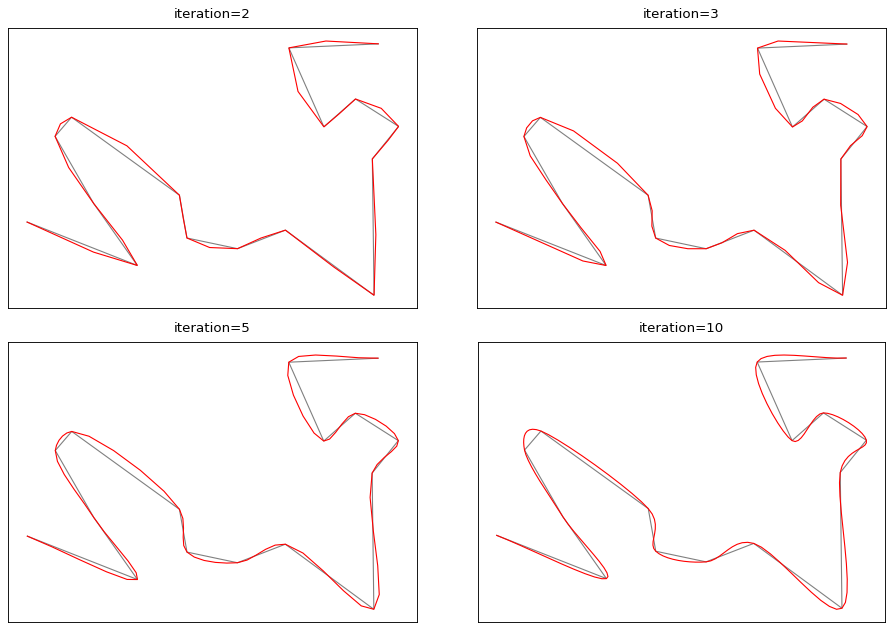
Smooth a line or polygon and preserve vertexes.
This algorithm was proposed by Catmull and Rom [1], this is the version proposed by Barry and Goldman [2] that makes use of the de Boor’s algorithm for evaluating spline curves in B-spline form.
Catmull-Rom splines are a family of cubic interpolating splines that pass through all control points. The alpha parameter controls the type of parameterization: 0 for uniform, 0.5 for centripetal (default), and 1 for chordal. Centripetal parameterization avoids cusps and self-intersections.
Accept Multi geometries. If a polygon is provided, it also applies the smoothing to its holes using the same parameters.
This implementation is a translation of the C++ implementation available here.
- Parameters:
geometry (
LineString,MultiLineString,Polygon,MultiPolygon,LinearRing) – The line or polygon to smooth. The spline passes through all original vertices.subdivisions (
int, optional) – Number of interpolated points between each pair of control points. Default is 10. Higher values produce smoother curves.alpha (
float, optional) –Parameterization type. Default is 0.5 (centripetal):
0.0: uniform parameterization
0.5: centripetal parameterization (recommended, prevents loops)
1.0: chordal parameterization
- Returns:
LineString,Polygon,MultiLineString,MultiPolygon,LinearRing– Smoothed geometry of the same type as input.
See also
smooth_chaikinSmooth a line or polygon by cutting corners.
References
Examples
>>> line = LineString([(0, 0), (1, 1), (2, 0), (3, 1)])
>>> smooth_catmull_rom(line, alpha=0.5, subdivisions=10)
<LINESTRING (0 0, 0.1 0.12, ... 3 1)>
>>> polygon = Polygon([(0, 0), (0, 2), (2, 2), (2, 0), (0, 0)])
>>> smooth_catmull_rom(polygon, alpha=0.5, subdivisions=20)
<POLYGON ((0 0.1, ... 0 0.1))>