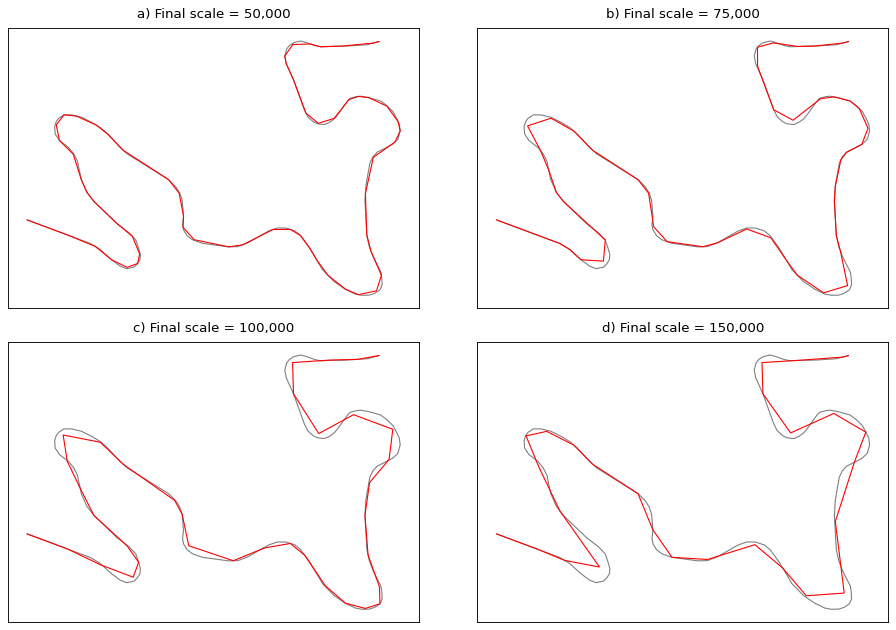
cartagen.simplify_raposo#
- simplify_raposo(geometry, initial_scale, final_scale, centroid=True, tobler=False)#
Simplify a line or a polygon using an hexagonal tessellation.
This algorithm proposed by Raposo [1] simplifies lines based on a hexagonal tessellation. The algorithm also works for the simplification of the border of a polygon object. The idea of the algorithm is to put a hexagonal tessellation on top of the line to simplify, the size of the cells depending on the targeted granularity of the line. Similarly to the Li-Openshaw algorithm, only one vertex is kept inside each cell. This point can be the centroid of the removed vertices, or a projection on the initial line of this centroid. The shapes obtained with this algorithm are less sharp than the ones obtained with other algorithms such as Douglas-Peucker.
The algorithm is dedicated to the smooth simplification of natural features such as rivers, forests, coastlines, lakes.
- Parameters:
geometry (
LineString,MultiLineString,Polygon,MultiPolygon,LinearRing) – The line to simplify.initial_scale (
float) – Initial scale of the provided line (25000.0 for 1:25000 scale).final_scale (
float) – Final scale of the simplified line.centroid (
bool, optional) – If true, uses the center of the hexagonal cells as the new vertex, if false, the center is projected on the nearest point in the initial line.tobler (
bool, optional) – If True, compute cell resolution based on Tobler’s formula, else uses Raposo’s formula
- Returns:
LineString,MultiLineString,Polygon,MultiPolygon,LinearRing
See also
simplify_angularSimplify a line or polygon by removing vertexes with small angles.
simplify_douglas_peuckerSimplify a line or polygon using a distance-based selection.
simplify_langSimplify a line or polygon using a look-ahead distance-based selection.
simplify_li_openshawSimplify a line or a polygon using a regular grid.
simplify_reumann_witkamSimplify a line or polygon using a directional distance-based selection.
simplify_visvalingam_whyattSimplify a line or polygon using an area-based selection.
simplify_wang_mullerSimplify a line or polygon using a bend-reduction method.
simplify_whirlpoolSimplify a line or polygon using an epsilon-circle based selection.
Notes
The Tobler based formula to compute hexagonal cell size is \(cellsize=5·l·s\) where \(l\) is the width of the line in the map in meters (e.g. 0.0005 for 0.5 mm), and \(s\) is the target scale denominator.
Raposo’s formula to compute hexagonal cell size is \(cellsize={l/n}·{t/d}\) where \(l\) is the length of the line, \(n\) the number of vertices of the line, \(t\) the denominator of the target scale, and \(d\) the denominator of the initial scale.
References
Examples
>>> line = LineString([(0, 0), (1, 1), (2, 0), (5, 3)])
>>> c4.simplify_raposo(line, 5000, 10000)
<LINESTRING (0 0, 1 0.3333333333333333, 5 3)>