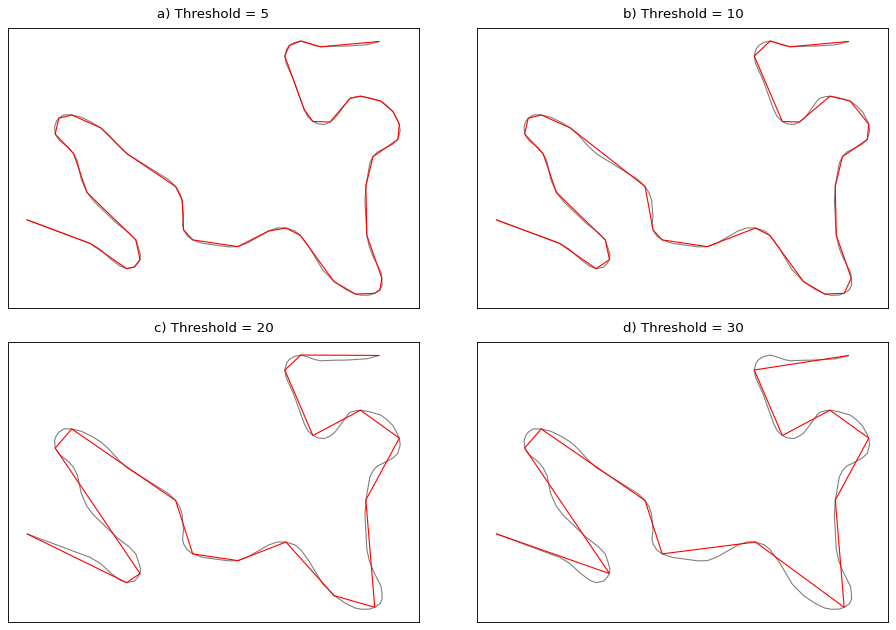
cartagen.simplify_douglas_peucker#
- simplify_douglas_peucker(geometry, threshold, preserve_topology=True)#
Simplify a line or polygon using a distance-based selection.
This algorithm was proposed by Ramer [1] and by Douglas and Peucker. [2] It is a line filtering algorithm, which means that it filters the vertices of the line (or polygon) to only retain the most important ones to preserve the shape of the line. The algorithm iteratively searches the most characteristics vertices of portions of the line and decides to retain or remove them given a distance threshold.
The algorithm tends to unsmooth geographic lines, and is rarely used to simplify geographic features. But it can be very useful to quickly filter the vertices of a line inside another algorithm.
This is a simple wrapper around
shapely.simplify().- Parameters:
geometry (
LineString,MultiLineString,Polygon,MultiPolygon,LinearRing) – The geometry to simplify.threshold (
float) – The distance threshold to remove the vertex from the line.preserve_topology (
bool, optional) – If set to True, the algorithm will prevent invalid geometries from being created (checking for collapses, ring-intersections, etc). The trade-off is computational expensivity.
- Returns:
LineString,MultiLineString,Polygon,MultiPolygon,LinearRing
See also
simplify_angularSimplify a line or polygon by removing vertexes with small angles.
simplify_langSimplify a line or polygon using a look-ahead distance-based selection.
simplify_li_openshawSimplify a line or a polygon using a regular grid.
simplify_raposoSimplify a line or a polygon using an hexagonal tessellation.
simplify_reumann_witkamSimplify a line or polygon using a directional distance-based selection.
simplify_visvalingam_whyattSimplify a line or polygon using an area-based selection.
simplify_wang_mullerSimplify a line or polygon using a bend-reduction method.
simplify_whirlpoolSimplify a line or polygon using an epsilon-circle based selection.
References
Examples
>>> line = LineString([(0, 0), (1, 1), (2, 0), (5, 3)])
>>> simplify_douglas_peucker(line, 1.0)
<LINESTRING (0 0, 2 0, 5 3)>